
 On 14 May 1948 the State of Israel was proclaimed according to the UN
partition plan (1947). Less than 24 hours later, the regular armies of
Egypt, Jordan, Syria, Lebanon and Iraq invaded the country, forcing Israel
to defend the sovereignty it had regained in its ancestral homeland. In
what became known as Israel's War of Independence, the newly formed,
poorly equipped Israel Defense Forces (IDF) repulsed the invaders in
fierce intermittent fighting, which lasted some 15 months and claimed over
6,000 Israeli lives (nearly one percent of the country's Jewish population
at the time).
On 14 May 1948 the State of Israel was proclaimed according to the UN
partition plan (1947). Less than 24 hours later, the regular armies of
Egypt, Jordan, Syria, Lebanon and Iraq invaded the country, forcing Israel
to defend the sovereignty it had regained in its ancestral homeland. In
what became known as Israel's War of Independence, the newly formed,
poorly equipped Israel Defense Forces (IDF) repulsed the invaders in
fierce intermittent fighting, which lasted some 15 months and claimed over
6,000 Israeli lives (nearly one percent of the country's Jewish population
at the time).
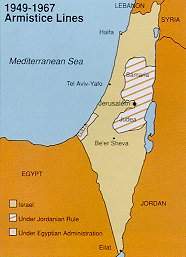 During the first few months of 1949, direct negotiations were conducted
under UN auspices between Israel and each of the invading countries
(except Iraq which has refused to negotiate with Israel to date),
resulting in armistice agreements which reflected the situation at the end
of the fighting. Accordingly, the coastal plain, Galilee and the entire
Negev were within Israel's sovereignty, Judea and Samaria (the West Bank)
came under Jordanian rule, the Gaza Strip came under Egyptian
administration, and the city of Jerusalem was divided, with Jordan
controlling the eastern part, including the Old City, and Israel the
western sector.
During the first few months of 1949, direct negotiations were conducted
under UN auspices between Israel and each of the invading countries
(except Iraq which has refused to negotiate with Israel to date),
resulting in armistice agreements which reflected the situation at the end
of the fighting. Accordingly, the coastal plain, Galilee and the entire
Negev were within Israel's sovereignty, Judea and Samaria (the West Bank)
came under Jordanian rule, the Gaza Strip came under Egyptian
administration, and the city of Jerusalem was divided, with Jordan
controlling the eastern part, including the Old City, and Israel the
western sector.
 Suez Canal; the blockade of the Straits of Tiran was tightened; incursions
into Israel of terrorist squads from neighboring Arab countries for murder
and sabotage occurred with increasing frequency; and the Sinai peninsula
was gradually converted into a huge Egyptian military base.
Suez Canal; the blockade of the Straits of Tiran was tightened; incursions
into Israel of terrorist squads from neighboring Arab countries for murder
and sabotage occurred with increasing frequency; and the Sinai peninsula
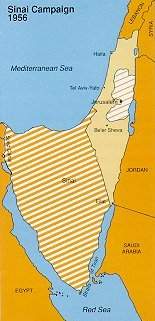
was gradually converted into a huge Egyptian military base.Upon the signing of a tripartate military alliance by Egypt, Syria and Jordan (October 1956), the imminent threat to Israel's existence was intensified. In the course of an eight-day campaign, the IDF captured the Gaza Strip and the entire Sinai peninsula, halting 10 miles (16 km.) east of the Suez Canal. A United Nations decision to station a UN Emergency Force (UNEF) along the Egypt-Israel border and Egyptian assurances of free navigation in the Gulf of Eilat led Israel to agree to withdraw in stages (November 1956 - March 1957) from the areas taken a few weeks earlier. Consequently, the Straits of Tiran were opened, enabling the development of trade with Asian and East African countries as well as oil imports from the Persian Gulf.
 neighboring Arab states. When Egypt again moved large numbers of troops
into the Sinai desert (May 1967), ordered the UN peacekeeping forces
(deployed since 1957) out of the area, reimposed the blockade of the
Straits of Tiran and entered into a military alliance with Jordan, Israel
found itself faced by hostile Arab armies on all fronts. As Egypt had
violated the arrangements agreed upon following the 1956 Sinai Campaign,
Israel invoked its inherent right of self-defense, launching a
preemptive strike (5 June 1967) against Egypt in the south, followed by a
counterattack against Jordan in the east and the routing of Syrian forces
entrenched on the Golan Heights in the north.
neighboring Arab states. When Egypt again moved large numbers of troops
into the Sinai desert (May 1967), ordered the UN peacekeeping forces
(deployed since 1957) out of the area, reimposed the blockade of the
Straits of Tiran and entered into a military alliance with Jordan, Israel
found itself faced by hostile Arab armies on all fronts. As Egypt had
violated the arrangements agreed upon following the 1956 Sinai Campaign,
Israel invoked its inherent right of self-defense, launching a
preemptive strike (5 June 1967) against Egypt in the south, followed by a
counterattack against Jordan in the east and the routing of Syrian forces
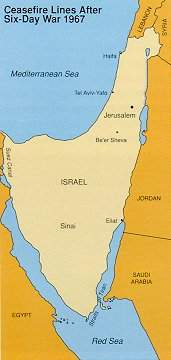
entrenched on the Golan Heights in the north.At the end of six days of fighting, previous cease-fire lines were replaced by new ones, with Judea, Samaria, Gaza, the Sinai peninsula and the Golan Heights under Israel's control. As a result, the northern villages were freed from 19 years of recurrent Syrian shelling; the passage of Israeli and Israel-bound shipping through the Straits of Tiran was ensured; and Jerusalem, which had been divided under Israeli and Jordanian rule since 1949, was reunified under Israel's authority.
 which called for "acknowledgment of the sovereignty, territorial integrity and political independence of every state in the area and their right to live in peace within secure and recognized boundaries free from threats or acts of force." However, the Arab position, as formulated at the Khartoum Summit Conference (August 1967) called for "no peace with Israel, no negotiations with Israel and no recognition of Israel." In September 1968, Egypt initiated a 'war of attrition,' with sporadic, static actions along the banks of the Suez Canal, which escalated into full-scale, localized fighting, causing heavy casualties on both sides. Hostilities ended in 1970 when Egypt and Israel accepted a renewed cease-fire along the Suez Canal.
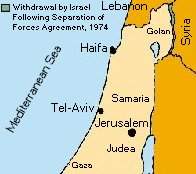 and Syria launched a coordinated surprise assault against Israel (6
October 1973), with the Egyptian army crossing the Suez Canal and Syrian
troops penetrating the Golan Heights. During the next three weeks, the
Israel Defense Forces turned the tide of battle and repulsed the
attackers, crossing the Suez Canal into Egypt and advancing to within 20
miles (32 km.) of the Syrian capital, Damascus. Two years of difficult
negotiations between Israel and Egypt and between Israel
and Syria resulted in disengagement agreements, according to which Israel withdrew from parts of the territories captured during the war.
and Syria launched a coordinated surprise assault against Israel (6
October 1973), with the Egyptian army crossing the Suez Canal and Syrian
troops penetrating the Golan Heights. During the next three weeks, the
Israel Defense Forces turned the tide of battle and repulsed the
attackers, crossing the Suez Canal into Egypt and advancing to within 20
miles (32 km.) of the Syrian capital, Damascus. Two years of difficult
negotiations between Israel and Egypt and between Israel
and Syria resulted in disengagement agreements, according to which Israel withdrew from parts of the territories captured during the war.
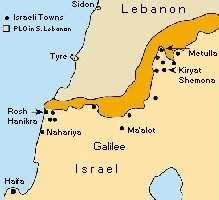 redeployed itself in southern Lebanon after being expelled from Jordan
(1970) and perpetrated repeated terrorist actions against the towns and
villages of northern Israel (Galilee), which caused many casualties and
much damage, the Israel Defense Forces crossed the border into Lebanon
(1982). "Operation Peace for Galilee" resulted in removing the bulk of the
PLO's organizational and military infrastructure from the area. Since
then, Israel has maintained a small security zone in southern Lebanon
adjacent to its northern border to safeguard its population in Galilee
against continued attacks by hostile elements.
redeployed itself in southern Lebanon after being expelled from Jordan
(1970) and perpetrated repeated terrorist actions against the towns and
villages of northern Israel (Galilee), which caused many casualties and
much damage, the Israel Defense Forces crossed the border into Lebanon
(1982). "Operation Peace for Galilee" resulted in removing the bulk of the
PLO's organizational and military infrastructure from the area. Since
then, Israel has maintained a small security zone in southern Lebanon
adjacent to its northern border to safeguard its population in Galilee
against continued attacks by hostile elements.
Copyright © 1995 - 2026 Ahavat Israel. All rights reserved.


